Any bicycle ride is a partnership between the rider and the machine. A good rider on an ill-fitting or poorly maintained bicycle can never reach the limits of their ability. Conversely, when the machine is more capable than the rider, the bicycle can never achieve what it was built to do.
Bicycles are made to fulfill different purposes. Road bikes, as found in the Tour de France, are as light as possible and designed for speed and handling. Mountain bikes are aimed at off-road use, where speed and weight are not as critical as navigating across a variety of unpaved terrain.
Touring bicycles are a blend of the road bike and the mountain bike, at home on or off the pavement. You could think of them as the minivan of the cycling world, a utilitarian vehicle created to transport people and their “stuff” wherever they may go.
A touring bike has several key characteristics which are common to the breed. Typically, they’re built of steel tubing, a material that has somewhat fallen out of favor in the bike world, but which is preferred for its durability and ride quality.
The wheelbase, the distance between the wheels front-to-back, is longer on a touring bike. This provides a smooth ride and more stable handling when carrying a load. That load is supported by another feature of the bike, a set of racks, front and rear, to which can be attached panniers for carrying the cyclist’s belongings.
A fully loaded touring bicycle in some cases can weigh over 100 pounds, so a wide range of gears is essential. Unlike a racing bicycle where the goal is to move as fast as possible, the goal of a touring bike is often just to be able to move at all. Thus, they’re equipped with a set of gear choices that favor ease of pedaling over top end speed.
I first met my bicycle touring partner on Facebook. Facebook Marketplace, that is. I regularly search for bicycles of interest and came across an ad for a 1984 Lotus Eclair one weekend, located just outside of Philadelphia. Lotus was a brand of Japanese made bicycles that were imported into the U.S. for about ten years in the 80’s and 90’s. The “Eclair” (pronounced “Ay-Clair”) name was a mystery, until a little investigation revealed that Eclair is the French word for “Lightning Bolt”. Owning a Lotus Lightning Bolt was acceptable to me, and preferrable to riding a Lotus Cream Filled Pastry Topped with Chocolate Icing kind of bike.
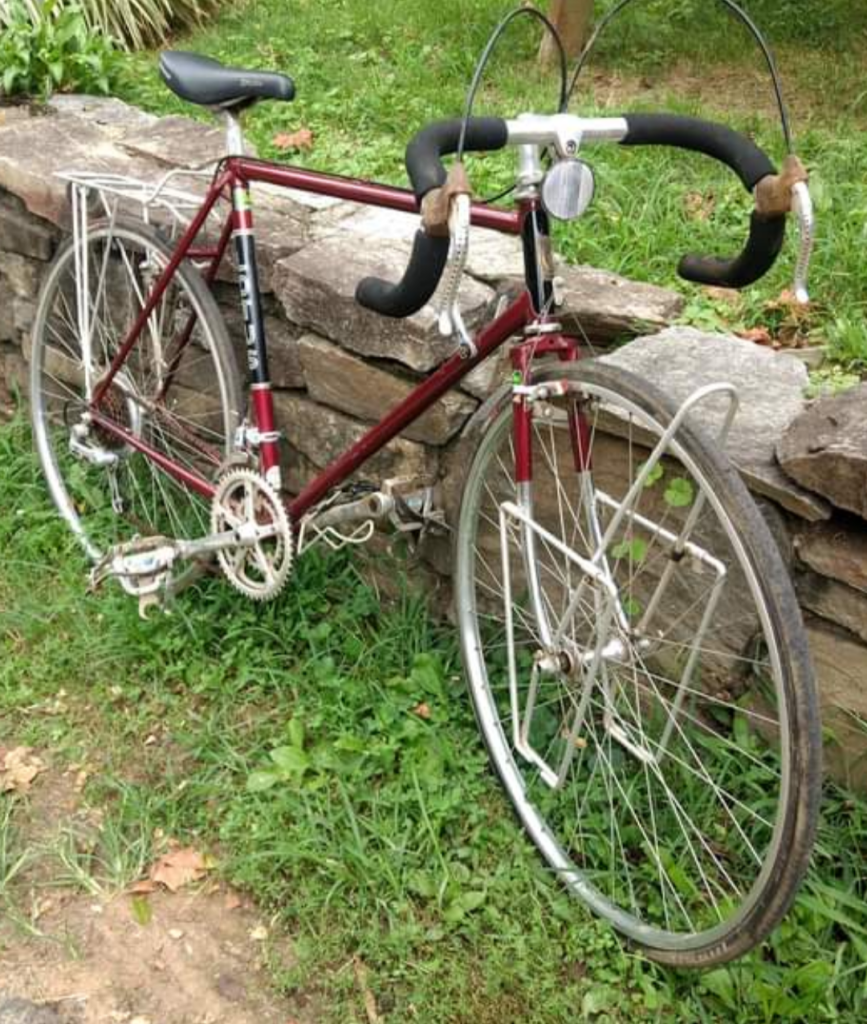
As I examined the pictures of the burgundy Lotus leaning against a stone wall, an idea began to form that buying this bicycle would be the first step towards doing what I wanted to do since my early 20’s – riding across America. The price was a reasonable $200 and with equivalent new bicycles selling for $1,500 and up, I quickly messaged the seller. Within a few hours the deal was made. Fortunately for me, the owner was about to travel to Detroit, so we agreed to meet in Toledo for delivery.
The Lotus arrived in the back of a Ford pickup alongside two other bikes, and the first glimpse was positive. The woman said that her husband acquired it after it was donated to a local bicycle co-op but had sat in storage since then. When I began the restoration process the next morning it was obvious she was telling the truth. Flecks of dried mud and bits of hay covered the bike, but dirt is a great preservative. After a couple hours of washing and detailing, I had the beginnings of an acceptable companion for my journey.
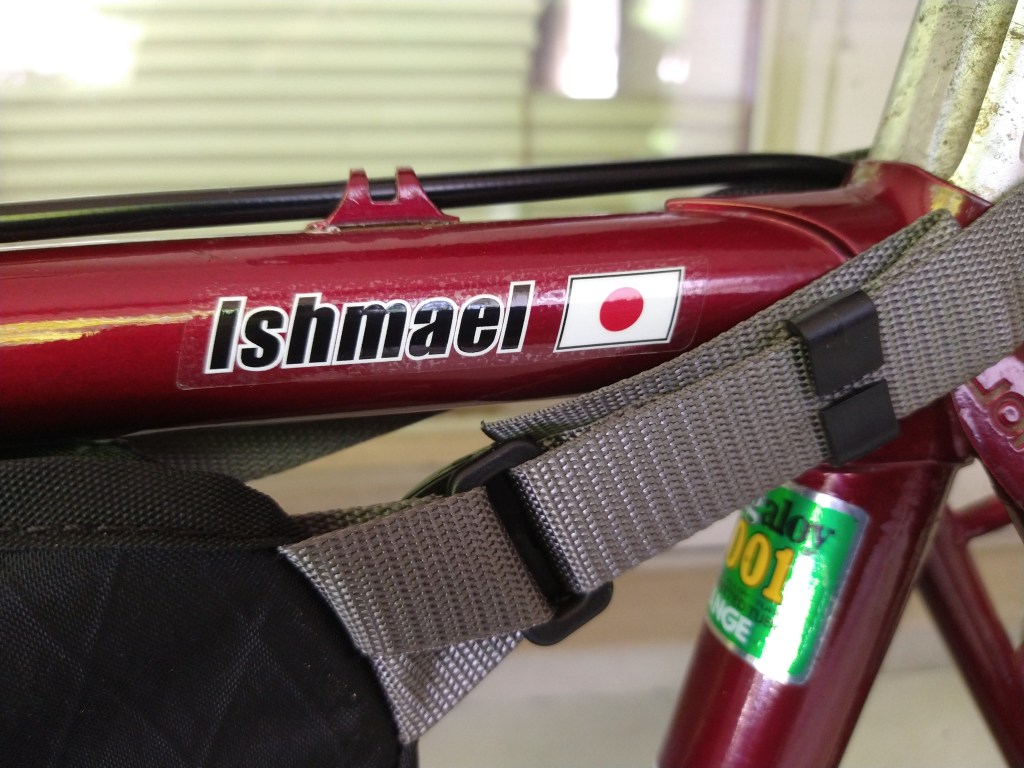
Because bicycle touring is a partnership, I needed to know what to call my colleague. If we were going to have to rely on each other for months on the road, calling it “the Lotus” or worse, “the bike”, simply wouldn’t do. I played around with names that echoed America, formal names, frivolous names and more, until the opening sentence of Herman Melville’s novel “Moby Dick” struck me like a harpoon: “Call me Ishmael“.
It was perfect. Melville’s Ishmael sought adventure on the seas, while my Ishmael was made to roam continents. Neither Ishmael nor I was capable of making the journey alone. If it wasn’t for me, he’d be leaning against a wall in Pennsylvania, and without him I’d be hiking across the U.S. Together, we had unfinished business. Me, to follow a decades old dream, and he to do what he was created to do.
Ishmael might have completed the trip as I found him, but he hadn’t changed a bit since leaving Japan 38 years earlier. Bicycle technology had evolved over that time, so parts that were common then aren’t easily available now. This could be a problem out on the road. Before I felt confident heading West, Ishmael needed a makeover. Touring cyclists prefer to have bikes that they can repair themselves, or at least be made rideable enough to get them to the nearest bicycle shop. The criteria for me were reliability, durability and repairability, and I knew exactly who to see to make it happen.
Michael Mathias owns Marion Cycle Works in Marion, Indiana. He’s an excellent mechanic and a great advisor on all things bicycle related. I brought Ishmael to the shop one Saturday morning and asked, “If you were going to ride this bike across the United States, what would you change?” A short time later I got an email listing his recommendations, which led me to doing something that never fails to make me happy: Buying more bike stuff. After a few weeks on the Internet a corner of one room looked like a bicycle shop, with Ishmael’s new parts shining like treasure. Following another trip to Marion to toss the hoard in Michael’s general direction, it was time to wait.
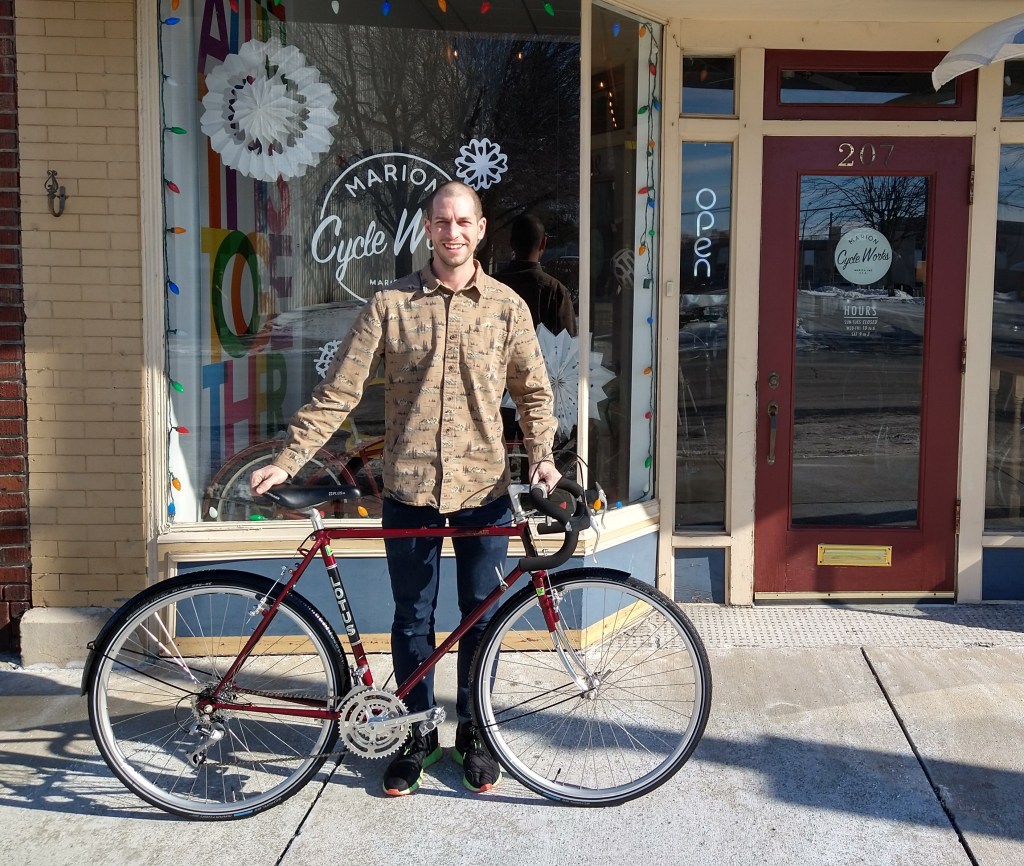
A few weeks later Ishmael was transformed, and Michael had done an outstanding job. New wheels were built up, which gave me better gearing choices and allowed the use of wider and more commonly found tires. Brakes were upgraded for improved stopping power. The derailleurs and crankset were replaced for reliability and easier pedaling with a load, and Ishmael now had fenders for comfort in bad weather and dusty conditions. Topping it off was a Brooks leather saddle from England, which is considered almost mandatory for a touring bicycle. With these improvements, Ishmael was now ready for an adventure, and it was my pleasure to plot our course.
 Saint Augustine To Seattle