Sometime around 1962 or 1963 I took my first bicycle ride without training wheels, and promptly crashed. As I remember it, I had no difficulty going in a straight line, but the nuances of changing direction hadn’t been completely worked out yet. When a turn was necessary, the lean of the bike suggested that I was about to go down, which became a self-fulfilling prophecy seconds later. Eventually, like the Wright Brothers early efforts, I traveled a little farther with each attempt, and boo-boos, band-aids and Mercurochrome became a thing of the past.
My first bicycle was obtained through an aunt, who had used it in her youth. Since it gave off an unmistakable “Girl’s bike” vibe with its step-through frame, my dad showed some ingenuity and mercy by closing the gap with some pegboard cut to size and a split garden hose for a top tube. This got me around the neighborhood reasonably well, and forestalled the taunts of other boys, but something better was coming.
A couple of years later on my birthday, it arrived: A Wards Hawthorne balloon-tired single speed with dual headlights. It was a little big for me, judging by the picture taken that day, but the phrase “He’ll grow into it.” applied to bicycles as well as clothes. The arrival of the Wards coincided with a greater desire to explore the area, with friends or alone. Five days a week it was off to school and back, helmetless and with a stack of books under one arm or clamped on a rack behind the seat, since both helmets and backpacks had not yet been invented. In my free time, I’d ride to friend’s houses or local attractions like 7-11, where two quarters would buy a comic book and an Icee. Life was good.
If you’re of a certain age, the name “Schwinn” used to mean something. In the 60’s no other bicycle manufacturer had the cachet of the brand. Sold only in Schwinn shops, they were even recommended by Captain Kangaroo, whose endorsement was infallible to my generation. One day a Schwinn “Stingray” appeared in the neighborhood, and what had been acceptable transportation suddenly wasn’t.
With high handlebars and a “banana” seat, plus a rear tire that looked like it came off a dragster, the Stingray was the ultimate kid’s bike. Objectively, my Wards was a better machine, but for the same reason men wear toupees and women walk around in uncomfortable shoes, style points count big. With a Stingray you could pop wheelies, come to a skidding stop, jump curbs and look as cool as James Dean doing it. Pre-driver’s license, this was as good as it got. Did I ever own one? No. With four siblings, it wasn’t my turn yet, so other guys got the Stingrays, and probably the girls. I’d have to wait for the next revolution in cycling.
In the early 70’s there was an energy “crisis” that caused gas prices to rise substantially. While this may seem like recent history, it led people to look for alternate transportation. Smaller cars, motorcycles and mopeds became more popular, but the sales of ‘ten-speed” bicycles took off like a home run baseball. When a friend acquired a Raleigh Grand Prix “genuine racing bike” and let me ride it, it was incredible. I had to have one.
However, the demand for ten-speed bikes was strong, and they were hard to get. Raleigh and Schwinn deliveries were out six months or more, and other brands weren’t much better. In the paper one day a local department store, Jordan Marsh, ran an ad for a “Joannou Racer”, a ten-speed for the price of $88. Of course, I didn’t have the money, but I knew who did. After hitting up Dad for the full amount, he talked it over with Mom and agreed to pay half, if I could come up with the rest.
Fortunately, a family in the neighborhood had a dog that needed to be walked every evening. The Oleck’s were nice people and “Joey”, the dog, was just as friendly. After three months of walks around the block at 50 cents per day, I had my share. Dad lived up to his end of the bargain, and a blue Joannou Racer came home from the store.
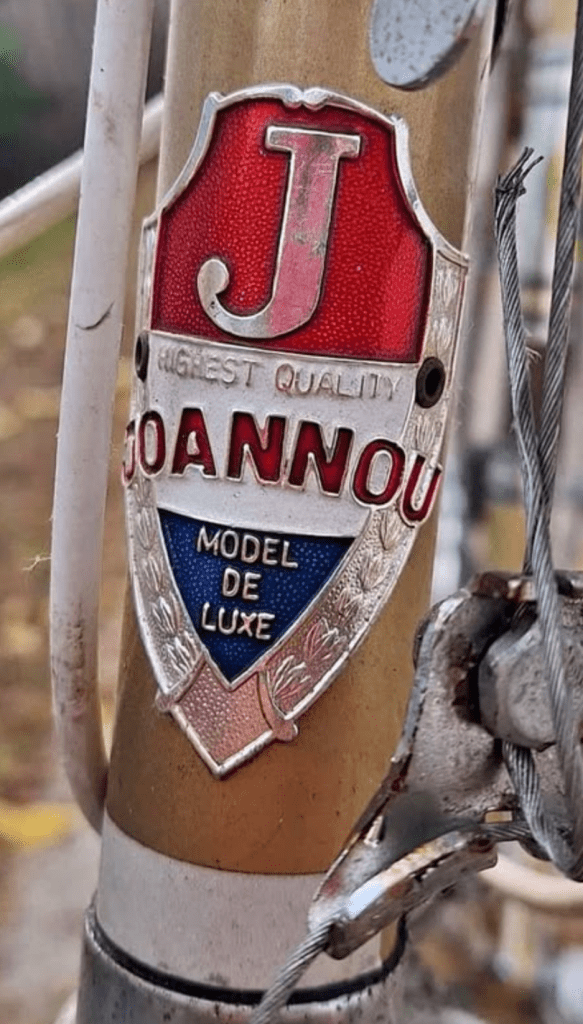
The Joannou served me well for several years but gradually wore out from use and unintentional abuse. Florida’s high humidity and regular rain showers were a steel bicycle’s worst enemy, and eventually turned its color from blue to a mixture of blue and rust red. By then, I had a driver’s license and a part-time job, which made the demise of the Joannou easier to take. I hadn’t lost interest in cycling, but college came first.
Four years later I was handed a diploma one Saturday afternoon and went straight to work on Monday morning. As a degreed member of the adult workforce with a regular paycheck, I was eager to satisfy a few wants that had built up while I’d perfected the role of an impoverished student. It was time for a new bicycle.
If the $88 Joannou Racer had seemed expensive to me nine years earlier, the $450 I was about to drop on a beautiful black and chrome Fuji S12-S Ltd at Orange Cycle Works felt reasonable now. No dog walking was required, and it was just one easy payment. Well, not that easy, but given that I still own and ride the bike today, it’s one of the best deals I ever made. The Fuji took me on hundreds of rides around Florida, two trips to the U.K., plus several tours in the U.S. It’s a lifetime bicycle, and still a joy.
Fast forward to today, and I’m still on the bike, or bikes. In the last few years the “herd” has grown to more than ten, but less than twenty, with machines from several countries represented. The joke that the number of bicycles a person should own can be calculated by the formula “N + 1”, where “N” is the number of bicycles currently owned, isn’t far from the truth. Each bicycle has a personality and something special about it, which can only be discovered after miles in the saddle.
I cycle about 5 to 6 thousand miles every year, with most miles accumulated after work or on weekends. Now, with the schedule cleared to do nothing but ride every day, it will be intriguing to see how I settle into the new pattern. At home, I can choose the weather and terrain I want to deal with, and there’s no obligation to ride at all if I decide not to. Going coast to coast changes everything. The obstacles along the way are the price of admission to the journey, and daily progress is a requirement. With over 50 years of cycling behind me, I’m still excited to see what’s up the road.
 Saint Augustine To Seattle